


What buyers should verify first
6061-T6 and 7075-T6 have nearly the same density, but they differ sharply in strength, corrosion behavior, weldability, availability and cost. Select the alloy from the load case and environment, then confirm the exact product form and temper on the drawing.
| Factor | 6061 | 7075 |
|---|---|---|
| Strength demand | Moderate structural loads | Higher strength-to-weight requirement |
| Welding | Generally preferred | Usually avoided for structural joining |
| Corrosion behavior | Good general resistance | Needs more attention in aggressive service |
| Machining | Very common and forgiving | Machines well but stock costs more |
| Typical choice | Housings, brackets, frames | Highly loaded aerospace-style hardware |
1. Start from loads and failure modes
Use engineering calculations, safety factors, fatigue, impact and joint behavior. Do not choose an alloy from tensile strength alone. A bracket limited by elastic deflection may gain little from switching alloy because their elastic moduli are similar. A compact bracket limited by yielding may benefit much more from 7075. Check fatigue, stress concentrations and fastener bearing loads before using a typical tensile value as a design allowable.
2. Specify temper, not only alloy
6061-T6 and 7075-T6 are meaningful conditions; an incomplete callout can lead to different properties and dimensional behavior. Include product form and thickness because certificate requirements depend on them. Stress-relieved plate and ordinary T6 stock are not interchangeable descriptions of residual-stress control. For a heavily pocketed part, discuss material condition and roughing sequence before committing to final flatness.
3. Consider the complete process
Machining, forming, welding, heat treatment, anodizing, masking and assembly may change the best choice. A welded frame may favor 6061, while a bolted high-load link may suit 7075. Welding can reduce properties locally even in 6061, so use the correct joint allowables. Approve appearance on the actual alloy because anodized color can vary between alloys and lots.
4. Review corrosion and contact pairs
Environment, coatings and galvanic contact with other metals can control service life. At a stainless fastener in an aluminum housing, trapped salt water can make the contact zone more important than the broad exposed surface. Evaluate isolation, drainage and coating coverage around the joint. Avoid assuming that a decorative anodized finish automatically protects every crevice.
5. Compare finished-part cost
Include stock availability, buy-to-fly ratio, cycle time, scrap risk, finishing and inspection: not only price per kilogram. If a part starts as 2 kg of stock but finishes at 0.3 kg, material yield makes a price premium more significant. For a compact part with little removal, programming and inspection may dominate instead. Compare quotations at the same quantity, stock form and certificate requirement.
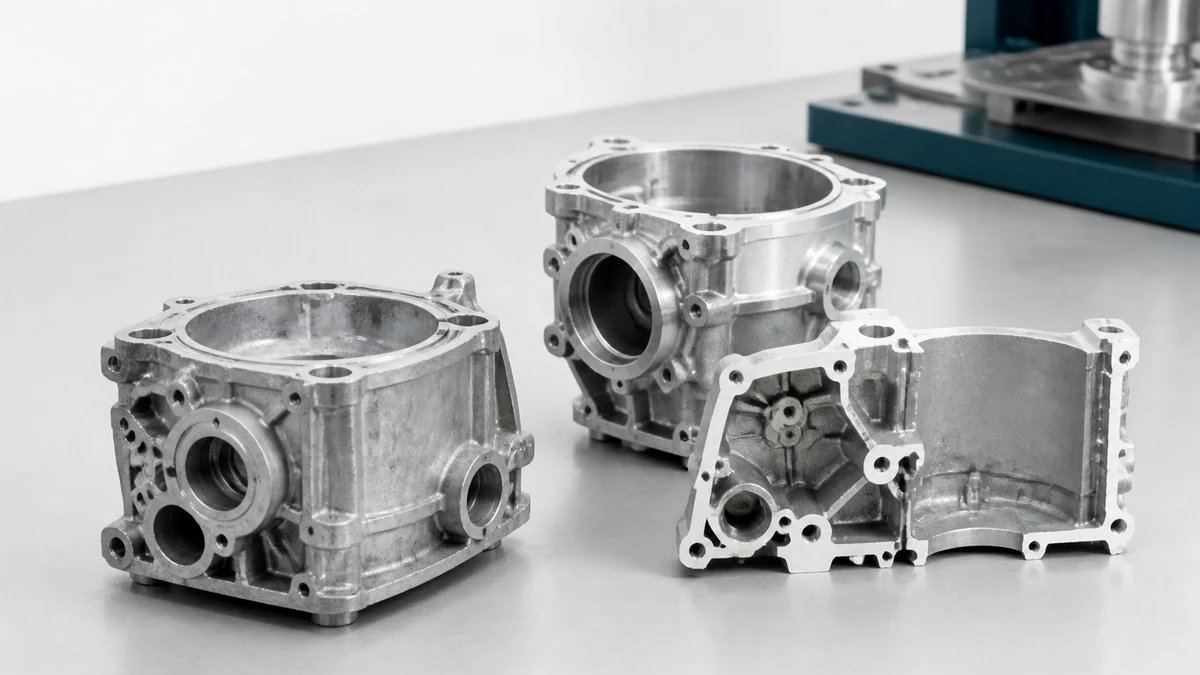
Typical 6061-T6 and 7075-T6 properties
| Factor | 6061-T6 | 7075-T6 |
|---|---|---|
| Density | About 2.70 g/cm³ | About 2.80 g/cm³ |
| Typical ultimate tensile strength | 310 MPa typical | 572 MPa typical |
| Typical yield strength | 276 MPa typical | 503 MPa typical |
| Relative material cost | Lower and widely available | Higher and more availability-sensitive |
| Common uses | Housings, brackets, frames and general structures | Highly loaded aerospace, robotics and performance structures |
These typical sheet and plate values are from Kaiser Aluminum data sheets, not guaranteed design allowables. Required minimum properties depend on product form, thickness, temper and governing specification. 7075-T6 offers much higher strength but is normally less weldable and less naturally corrosion resistant than 6061-T6. For a stiff but lightly loaded housing, 6061 may deliver the required function at lower material and processing risk. For a compact highly loaded arm, verified 7075 properties may justify the premium.
Practical buyer scenario
A protective electronics housing may gain little from 7075 if wall stiffness and sealing dominate. A compact, highly loaded bracket may justify it after corrosion and joining are addressed.
Topic-specific review checklist
- Product form and governing material specification
- Temper and thickness used for property comparison
- Static, fatigue and impact load cases
- Corrosion environment and protective finish
- Welding or forming requirement
- Material availability and certificate traceability
Frequently asked questions
Is 7075 always better?
No. It is stronger in common tempers, but the best alloy depends on environment, joining, geometry, supply and cost.
Can both alloys be anodized?
Yes, but appearance and process response differ; approve a representative sample.
Which is easier to source?
6061 is generally more widely available, but confirm the exact form and temper with the supplier.
Can I substitute one for the other?
Only after engineering approval; properties and process behavior are not interchangeable.
Sources and further reading
- Kaiser Aluminum 6061 sheet and plate technical data
- Kaiser Aluminum 7075 sheet and plate technical data
Discuss this drawing requirement with WEKO before releasing material or committing the production route.