


What buyers should verify first
A supplier's label is less important than the controls behind the order. Verify who owns the machines, who approves subcontractors and who remains accountable when material, dimensions or delivery fail.
| Review area | What good control looks like | Buyer action |
|---|---|---|
| Business identity | Same legal name through contract, payment and export documents | Mismatch requires explanation |
| Factory evidence | Live shop-floor route tied to the quoted processes | Stock videos are weak evidence |
| Technical depth | Specific answers about datums, workholding and inspection | Generic replies indicate handoff |
| Commercial trail | Invoice and beneficiary fit the disclosed structure | Third-party payment is a red flag |
| Outsourcing | Approved external steps are named and controlled | Hidden outsourcing is unacceptable |
1. Check identity before capability
Request the Chinese legal name, unified social credit code, registered address and business scope. Translate the record independently and confirm the payee. Multiple entities can be legitimate, but their roles must be written into the contract. Check the registration against an official business registry and record the date of the check. A different bank beneficiary needs a documented explanation before payment, rather than a verbal assurance from sales.
2. Run a live process challenge
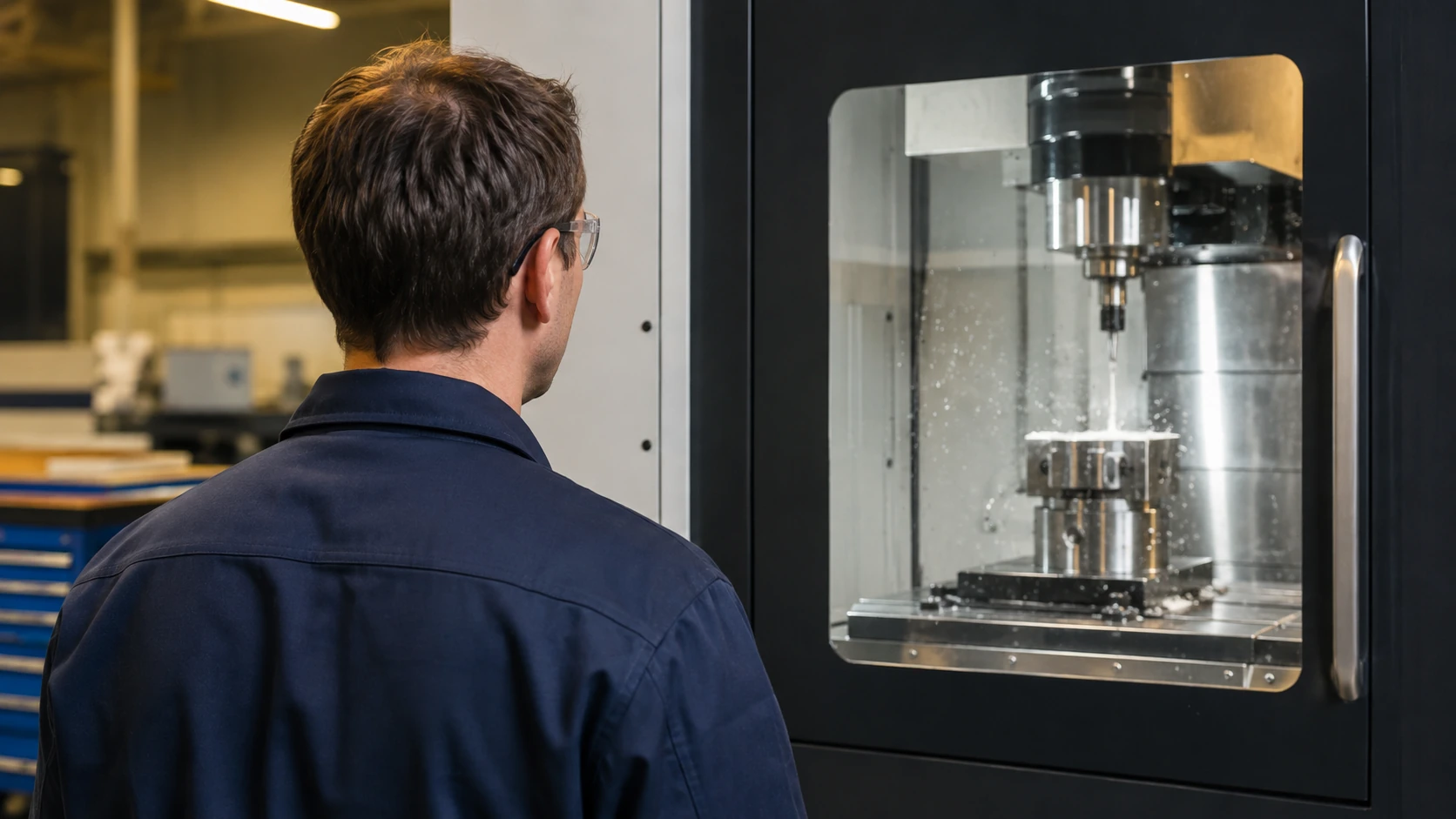
Choose a distinctive feature from your drawing and ask the contact to walk to the machine, fixture or gauge used for it. Ask questions that require immediate shop-floor knowledge. For example, a supplier quoting five-axis milling should identify the machine, workholding and tool access for the proposed part. If the machine is at a partner site, ask for that site's identity and the inspection handoff instead of treating an unrelated machine video as proof.
3. Inspect document behavior
Real process control appears in revision stamps, travelers, tool lists, lot labels and inspection records. Marketing brochures alone do not show who controls production. Select a drawing revision yourself and ask the operator to retrieve the matching setup sheet. A newer file on the sales laptop does not establish that the machine is running the same revision. Record any mismatch and ask how obsolete copies are withdrawn.
4. Map every external process
Heat treatment, anodizing, plating and special testing may be subcontracted. Record supplier approval, incoming verification, transport protection and responsibility for defects. For anodized housings, follow one dispatch note to the finishing return and final dimensional report. Confirm who accepts coating thickness, color and masked bearing seats. An integrator can provide strong control when these handoffs are visible and contractually assigned.
5. Protect the pilot order
Use a small, representative order and require material evidence, first-article results and packaging photos before balance payment. Choose a part that includes the difficult bore, thread or cosmetic surface from the intended order. Compare the actual traveler and measured results with the quoted route. Release further volume only when the pilot resolves the specific uncertainty that prompted the trial.
Factory or trading company: a practical decision
| Check | Strong evidence | Red flag |
|---|---|---|
| Legal identity | Business licence, invoice entity and payment beneficiary agree | Different company names without a written explanation |
| Production ownership | Live work orders can be traced to named machines and operators | Only showroom photos or edited videos are available |
| Subcontracting | Approved processes, suppliers and incoming checks are disclosed | Outside processing is denied or cannot be traced |
| Quality responsibility | One owner controls NCR, corrective action and release | Problems are passed between unrelated parties |
Example: verify a five-axis machining claim
A supplier quoted a complex housing as five-axis work but could not identify the machine, fixture or program owner. The buyer requested a live review of a comparable work order, a machine asset record and an inspection report tied to the same shop. The supplier then disclosed that machining would be outsourced. Outsourcing was not automatically disqualifying, but the buyer required the subcontractor, inspection responsibility and change-notification rule to be named before approval.
Practical buyer scenario
If a supplier quotes five-axis milling but cannot show the machine, controller, fixture concept or tool-access plan, treat the process as outsourced until verified.
Topic-specific review checklist
- Confirm the legal entity, invoice entity and bank beneficiary
- Match quoted processes to visible equipment or disclosed partners
- Trace one material lot from receipt through shipment
- Identify who approves outside processing and process changes
- Name the owner of inspection reports and corrective action
- Record permitted subcontracting in the purchase order
Frequently asked questions
Is factory-direct always cheaper?
Not necessarily. The important question is whether margins, accountability and process ownership are transparent.
Can the bank account belong to another company?
Sometimes an export entity is used, but obtain a written relationship explanation and verify it before payment.
Are video calls reliable?
Live calls are useful when you control the route and ask real-time technical questions.
What is the clearest red flag?
Refusal to identify the manufacturing site or explain who owns quality responsibility.
Sources and further reading
Discuss this drawing requirement with WEKO before releasing material or committing the production route.