


What buyers should verify first
A low MOQ does not remove programming, setup, tooling or first-article inspection. It means the supplier accepts a small order; the fixed work is simply divided across fewer pieces.
| Review area | What good control looks like | Buyer action |
|---|---|---|
| Engineering/programming | Interpretation, CAM and simulation | Often reusable after revision freeze |
| Setup/fixture | Workholding, offsets and first-off proof | May recur by batch |
| Tools | Standard or special cutters, jaws and gauges | Ownership should be clear |
| Inspection | FAI, reports, CMM program or gauges | Driven by requirements |
| Production | Material plus machine cycle | Scales with quantity |
1. Ask for a cost bridge
Request price at several quantities and identify which charges are one-time, per batch and per part. Ask for comparable quotations at 5, 50 and 500 pieces using the same drawing and finish. Separate new fixture investment from costs that recur every time the machine is set up. Otherwise, an apparent volume discount can conceal a change in inspection or material assumptions.
2. Keep the prototype representative
If production will use different fixtures, tools or material form, ask what must be revalidated before scaling. A prototype milled individually from a block may prove fit without proving the production cycle. If the volume route uses a dedicated fixture, check clamping distortion and datum repeatability on the pilot. Treat the first production-intent article as a separate approval when the route changes materially.
3. Clarify reusable assets
Define who owns soft jaws, fixtures, gauges and programs, how long they are retained and whether revision changes invalidate them. List the assets, their identification and the conditions for reuse on the next order. A worn soft jaw or obsolete program may need replacement even when ownership is clear. Specify retention time and retrieval arrangements so a low repeat price does not depend on an undocumented assumption.
4. Reduce avoidable fixed work
Use standard materials and tools, clear drawings, consolidated revisions and proportionate inspection. Consolidate design comments before releasing the machining package. Three successive revisions can cause repeated programming and first-off checks even when the final geometry looks simple. Ask the supplier which changes affect fixed work and which merely change the recurring cycle.
5. Buy learning, not only parts
Use the pilot to validate fit, finish, measurement method, packaging and communication before a larger commitment. Reserve pieces for assembly, functional testing and a retained reference sample. Record results by part identity so a failure can be traced to its measurements. A useful pilot closes the manufacturing questions needed for the next order rather than producing an attractive sample with no process record.
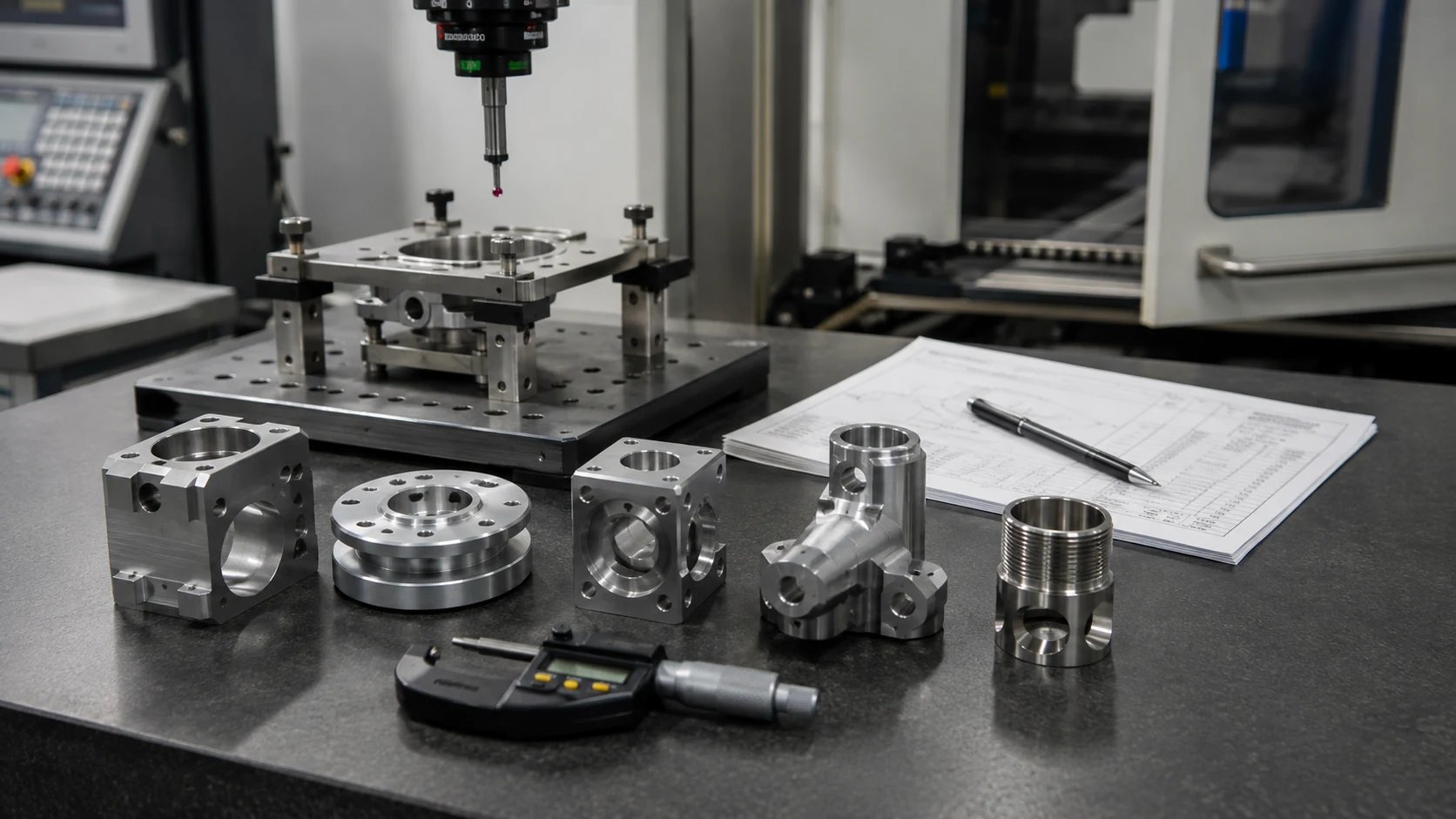
Illustrative cost structure at 5, 50 and 500 pieces
| Quantity | Fixed engineering, setup and FAI | Variable machining and material | Illustrative total | Illustrative unit cost |
|---|---|---|---|---|
| 5 | $450 | $35 each | $625 | $125.00 |
| 50 | $650 with a production fixture | $22 each | $1,750 | $35.00 |
| 500 | $1,200 with optimized tooling and fixture | $14 each | $8,200 | $16.40 |
The numbers are illustrative, not a WEKO quotation. They show why unit price falls as fixed cost is spread and cycle time is improved. At higher volume, additional fixture or tooling investment can increase fixed cost while reducing variable cost. Ask the supplier to separate engineering, programming, setup, special tooling, inspection and recurring piece price so alternatives can be compared.
Practical buyer scenario
Five parts may appear expensive because CAM, setup and first-article inspection are spread across five units. At 500 units, cycle time and material yield become more important.
Topic-specific review checklist
- Prototype, pilot and annual quantities
- Engineering and programming charge
- Setup and first-article inspection scope
- Special fixture and tool ownership
- Material minimum purchase quantity
- Recurring cycle time and inspection cost
- Reorder conditions and price-break assumptions
Frequently asked questions
Is “no MOQ” the same as cheap one-off parts?
No. It means the supplier accepts the order, not that fixed setup costs disappear.
Can setup fees be waived?
They may be embedded in unit price; compare total cost and repeat-order treatment.
What makes a prototype quick-turn?
Available material, standard tools, clear inputs, simple finishing and reserved capacity.
Should I order extra pieces?
Extra pieces can be economical when setup dominates, but order only what supports testing and risk.
Sources and further reading
Discuss this drawing requirement with WEKO before releasing material or committing the production route.