


Choose from function, not material reputation
Neither family is universally superior. A motor housing may need low mass, machinability and heat conduction, while a shaft may need strength, fatigue resistance and a durable bearing surface. Start with the load path, environment, interface and production volume. Then compare a specific alloy and condition, such as 6061-T6 aluminum against 304 or 316 stainless steel.
| Selection factor | Aluminum | Stainless steel |
|---|---|---|
| Density | About one third of stainless steel | Higher mass but greater stiffness by section |
| Heat conduction | Generally much higher | Lower, which can retain heat |
| Strength and wear | Alloy-dependent and often lower | Often better for shafts, threads and loaded interfaces |
| Corrosion | Often needs a suitable finish | Good when grade and environment are matched |
| Machining | High removal rates are usually possible | More heat, work hardening and tool wear |
| Finish | Anodizing and conversion coating | Passivation, polishing and specialized coatings |
Motor housings and covers
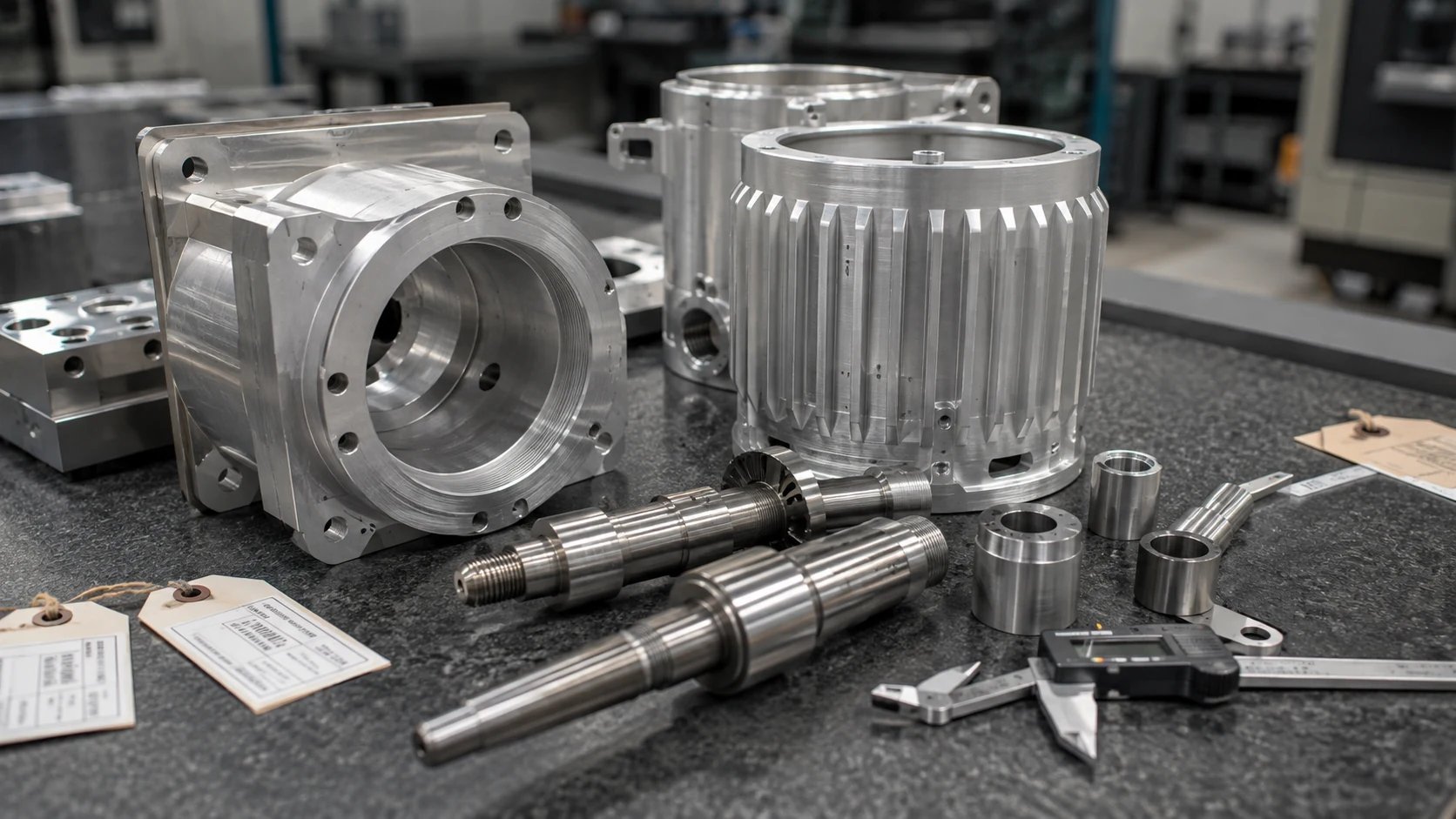
Aluminum reduces assembly mass and conducts heat away from stators, bearings and electronics. It machines efficiently and can integrate ribs, pockets and mounting features. The design still needs sufficient wall thickness and a plan for distortion. Bearing seats, sealing faces and grounded areas must account for anodizing or other surface treatment.
Shafts, sleeves and threaded hardware
A suitable stainless grade can carry concentrated loads or survive moisture and chemicals. Austenitic grades such as 304 and 316 are not automatically wear-resistant bearing materials, so sliding contacts require a separate hardness, lubrication and galling review. Grade matters: 304 provides broad corrosion resistance, 316 improves resistance in many chloride environments, and precipitation-hardening grades can offer much higher strength. Stainless also demands appropriate tools, cutting data and control of heat and burrs.
Machining and dimensional stability
Aluminum allows faster cutting but thin sections can move as residual stress is released. Stainless steel cuts more slowly and can work harden if tools rub. For both materials, define the stock condition, machining sequence and critical final features. Do not assume the machine's positioning specification equals stable part capability.
Surface finish and assembly interfaces
Anodizing can improve aluminum corrosion and wear performance while changing dimensions on close fits. Stainless passivation removes free iron and supports corrosion resistance but does not add a thick dimensional layer. State masking, appearance, thickness where applicable and whether dimensions apply before or after treatment. Keep mating electrical, sealing and bearing interfaces explicit.
Worked selection example
Consider a sealed robot joint with an aluminum outer housing, stainless output shaft and steel bearings. Aluminum is attractive for the large housing because reducing its mass saves more weight than changing a small shaft, and the broad wall area can spread heat. The shaft remains stainless because it carries concentrated load and presents bearing, thread and seal interfaces. The assembly drawing must still address galvanic contact, thermal expansion, fastener preload and the finished size of coated surfaces. A mixed-material answer can therefore outperform a one-material rule.
Cost and sourcing implications
Material price is only one part of the decision. Aluminum often supports shorter cycles and longer tool life, but anodizing, masking and cosmetic control add outside-process risk. Stainless stock may cost more and machine more slowly, yet it can avoid a coating in some environments. Compare quotations using the same certificate, inspection and finish requirements. For repeat orders, confirm stock form and availability because changing plate, bar or temper can alter both properties and dimensional stability.
Verification before release
Request a certificate tied to the received material lot and verify condition or temper when it changes performance. Review a production-intent first article after all specified finishes, then confirm bearing installation, sealing, fastening and thermal contact in the assembly. For repeat orders, retain the approved route and require notification before the supplier changes stock form, material source or outside processor. This closes the gap between a material choice on paper and a component that performs consistently. Document the approved material, finish and inspection evidence so the next order repeats the same technical baseline.
Decision guide
- Choose aluminum when weight, heat transfer and machining speed dominate.
- Choose stainless steel when strength, wear or environmental resistance dominates.
- Use inserts, sleeves or mixed-material assemblies when one component needs both sets of properties.
- Validate galvanic compatibility, thermal expansion and fastening when materials are mixed.
RFQ information
- Exact alloy, grade and condition
- Functional loads and environment
- Critical fits, threads and datums
- Finish and masking zones
- Prototype and production quantities
- Material certificate and inspection needs
Frequently asked questions
Is stainless steel always stronger? Many stainless grades are stronger than common machining aluminum, but the answer depends on the exact alloy, temper, heat treatment and load case.
Can aluminum replace stainless steel in a shaft? Sometimes for lightly loaded or weight-critical designs, but bearing wear, fatigue, stiffness and surface treatment require engineering review.
Which material is better for motor heat dissipation? Aluminum normally conducts heat much better, but the complete thermal path also depends on contact flatness, wall geometry, airflow and interface materials.
Can 316 stainless eliminate corrosion risk? No. Grade selection must consider the actual chemical and chloride exposure, temperature, surface condition, crevices and cleaning process.
Sources and further reading
Property and finish guidance must be confirmed for the exact alloy, product form, drawing and service environment.