


Identify the electrical and moisture paths
Galvanic corrosion requires more than two different metals appearing in the same assembly. Review electrical contact and an electrolyte path, such as trapped water containing salts. A joint that stays dry behaves differently from one exposed to condensation, washing or outdoor spray. Map those conditions at the fastener, washer, housing and mating component rather than treating the broad exterior surface as the complete corrosion problem.
Review the exposed areas
The relative exposed areas of the coupled materials can influence how severe localized attack becomes. A small damaged region of aluminum connected to a much larger protected metal surface can be important even when most of the housing looks sound. The exact environment and materials still govern the assessment. Use the assembly configuration when selecting controls, and avoid predicting service life from a simplified materials ranking alone.
Design isolation as a complete path
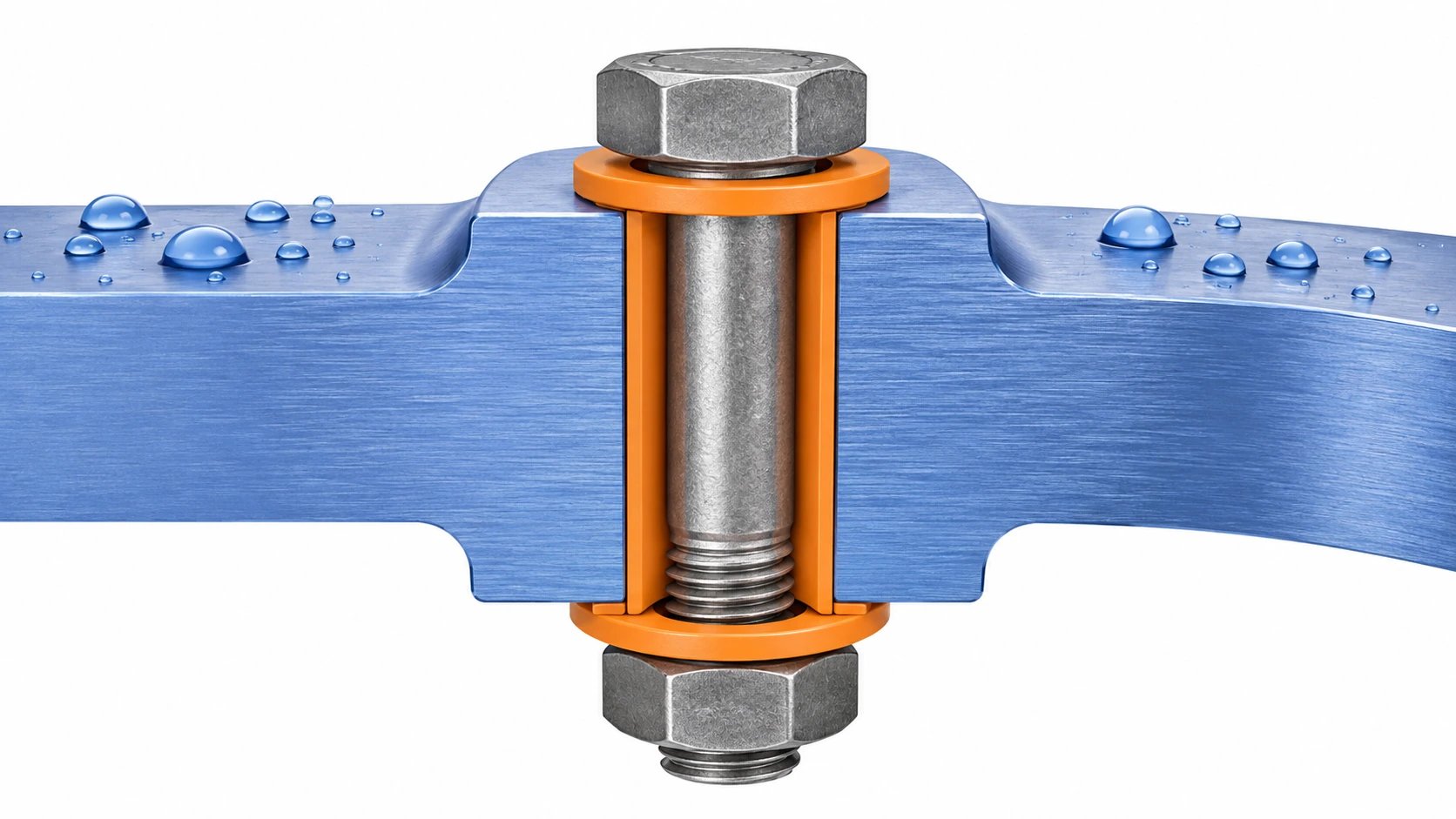
An insulating washer may separate a bolt head from the housing while the shank still contacts the bore. Check every conductive path before describing a joint as electrically isolated. A shoulder washer, sleeve or other arrangement may be needed, subject to the mechanical design. Verify that the isolation material can withstand load, temperature, creep and the installation process without compromising the fastening function.
Protect coating continuity
Coatings can help control exposure, but threads, sharp edges, masked areas and installation damage can interrupt coverage. Identify where metal-to-metal contact is intentional, particularly for grounding. Discuss coating thickness and fastener clearance together so assembly does not scrape away the protection. Inspect representative installed joints, not just loose coated parts, when installation is a likely source of damage or a path for water ingress.
Give water a route out
Sealing and drainage choices should reflect the expected exposure and maintenance. A partially sealed pocket can trap moisture around the fastener rather than keeping it dry. Review orientation, crevices and capillary paths with the product designer. Cleaning chemicals and residues can change the environment, so include them in the specification instead of assessing only fresh water at room temperature.
Validate the joint under relevant conditions
Select a test or assessment that represents the materials, finish, assembly and service exposure. A standard salt-spray result can support a coating comparison but should not be converted directly into years of service. Inspect critical contact zones after testing and document any loss of function. Record the approved coating and fastening details so a later substitution does not silently remove the corrosion-control measure.
Approval checklist and evidence
| Review item | Decision to make | Evidence to retain |
|---|---|---|
| Electrical path | Trace every metal contact through the whole joint. | Section review including bolt shank and mating parts. |
| Wet exposure | Identify trapped moisture, salts and cleaning residues. | Recorded environment and maintenance assumptions. |
| Isolation | Check washers, sleeves and unintended bypass contacts. | Installed-joint review plus mechanical suitability evidence. |
| Protection | Inspect coating and seal condition after fastening. | Relevant exposure assessment and final functional result. |
Worked review example
Illustrative scenario: stainless bolts secure an anodized aluminum cover in an outdoor assembly. A flat insulating washer is added under each head, but the uninsulated shank contacts the hole and water remains in the recess. The washer therefore does not establish complete electrical isolation. The design review should examine the entire contact path, drainage and installed coating condition. It may lead to a different isolation arrangement or a different protection strategy, with mechanical and corrosion performance validated together.
Information for the engineering review
- Exact mating materials and finishes
- Wet, chemical and cleaning exposure
- All conductive contact paths
- Coating damage after installation
- Drainage, sealing and validation conditions
Discuss this requirement with WEKO using the controlled drawing, the relevant mating interfaces and the review information above. Identify the decision that needs confirmation and the acceptance evidence expected with the first parts.
Sources and further reading
Frequently asked questions
Is anodizing enough by itself?
It depends on continuity, damage, exposed areas and the service environment. Review the installed joint.
Can isolation conflict with grounding?
Yes. An intentional electrical contact and corrosion control must be designed together rather than solved independently.